
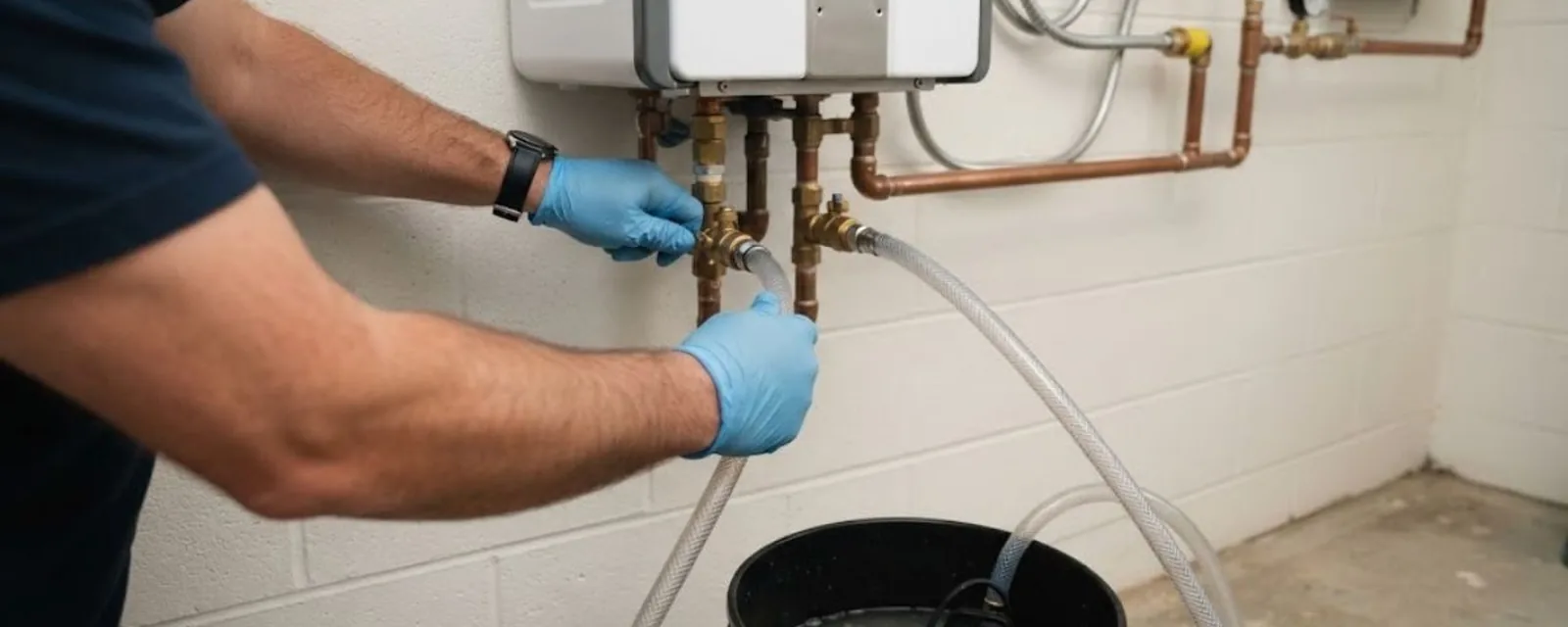
A tankless water heater needs periodic flushing even when the local water is soft. The heat exchanger is a narrow passage where water meets very high heat, so mineral film and sediment collect there more quickly than in a tank. A flush clears that film, cleans the inlet filter and keeps the unit running at its rated efficiency.
A common recommendation is once a year, but the manufacturer's manual sets the schedule.
Skipping maintenance usually shows up as error codes, lukewarm water, a unit that cycles on and off, longer waits for hot water or higher gas use. By that point the film has built up, and a service call costs more than routine upkeep would have.
Why soft water changes the picture
Hardness is the amount of dissolved calcium and magnesium in the water. Hard water leaves scale quickly. Soft water leaves far less. That is a real advantage in Happy Valley, where Sunrise Water Authority describes its supply as generally soft at about 1.2 grains per gallon.
In a soft-water area, a tankless heater may go longer between descalings than in a hard-water area. But sediment, fine debris and mineral film still collect, and the inlet screen still catches particles.
What a flush involves
The plumber closes the isolation valves, connects hoses to the service ports, and circulates a descaling solution through the heat exchanger with a small pump for a set time. The unit is then rinsed with clean water, the inlet filter is removed and cleaned, and the valves are returned to normal positions.
The plumber checks the flame, the vent and the condensate drain on condensing models, and reads any stored error codes.
| Step | Purpose |
|---|---|
| Close isolation valves | Direct flow through the service hoses |
| Circulate descaler | Dissolve mineral film in the heat exchanger |
| Rinse with clean water | Remove solution and loosened debris |
| Clean the inlet filter | Restore full flow |
| Check vent, flame, condensate | Confirm safe combustion and drainage |
| Review error history | Spot developing problems |
Tankless heater overdue for a flush?
Call and a plumber will schedule a flush and check the filter, sensors and vent.
Warning signs it is overdue
Watch for error codes, especially ones related to ignition, flow or overheating. Lukewarm water when the flow is moderate, a unit that shuts off during a shower, a noisy heat exchanger or a long delay before hot water arrives are all clues. Rattling or popping sounds can mean scale. A drop in water flow can mean a clogged inlet filter.
Things to avoid
- Do not run vinegar through the unit unless the manufacturer's manual allows it.
- Do not skip closing the isolation valves, which sends solution into the house plumbing.
- Do not ignore repeating error codes. Write them down and call for service.
- Do not delay if the unit is under a warranty that requires documented maintenance.
Can you do it yourself?
Some owners flush their own units with a pump kit. It is practical if you are comfortable with valves and hoses and follow the manual. Others prefer a plumber, who also inspects the vent, the gas connection and the sensors during the same visit. Gas and combustion safety checks are the part to leave to a professional. Our tankless water heater page lists what service involves.
Happy Valley note: permits and local conditions
Happy Valley's Building Division administers the state's plumbing and gas codes locally, and a flush is routine maintenance, so it does not usually involve a permit, but a unit replacement or a conversion can. Rules vary by project, so ask the building department.
Homes in Happy Valley are mostly newer, so many tankless units here are early in their lives, which is the best time to set up an annual service habit. Sunrise Water Authority's supply comes mainly from the Clackamas River, with the utility's own wells added at times of peak demand, so water chemistry can shift a little through the year.
Keeping the schedule
Put the service date on your calendar, note the last flush in the manual and keep a record for warranty purposes. If you move into a home with a tankless heater, ask for the service history. If there is none, schedule a first flush soon. Owners in Damascus or Clackamas on well-fed or mixed supplies may want to ask their provider about hardness.
What a service record should include
Keep a simple record of each service, and ask your plumber to fill it in. A useful entry lists the date, the unit's make and model, the water pressure and temperature readings, whether the inlet filter was clean or clogged, the condition of the vent and condensate drain and any error codes found in the history. Photos of the filter before and after tell you how fast debris is collecting.
Over several visits, the record shows patterns. A filter that is always clogged may point to a problem upstream, such as a failing pressure regulator or debris from the main. Error codes that repeat suggest a part is wearing. A unit whose descaling solution comes out cloudy each year shows that film is building, even in soft water.
Records also help if the heater is under warranty. Manufacturers often ask for proof of regular maintenance when a claim is made. A dated record from a plumber, along with the receipt, is far stronger than a memory. If you buy a home with a tankless unit and no records, treat the first service as a baseline and start the log from there.
Signs the descaling worked
After a flush, flow at the taps should feel steadier and the unit should reach temperature quickly. Error codes should clear and stay clear. The rinse water should run clean, and the removed inlet filter should be free of grit. If problems return within weeks, the cause is probably not scale, and a plumber should check the sensors, the vent and the gas supply instead of repeating the flush.
Safety steps before you start
- Turn off power at the breaker or the gas control, and let the unit cool before touching any valve.
- Never run the unit dry or with the isolation valves closed while it is firing.
- Wear gloves and eye protection when handling descaling solution, and keep it away from skin.
- Do not vent descaling fumes into a closed room. Open a window and keep children and pets out.
Flushing follows the maker's instructions, and the Oregon Plumbing Specialty Code (OPSC), based on the Uniform Plumbing Code (UPC), covers the isolation valves and relief piping.
Tankless flush questions
Yes, though less often than in hard-water areas. Sediment and mineral film still collect, and the inlet filter needs cleaning.
A common guideline is once a year, but follow the manufacturer's manual and your water conditions.
Sunrise Water Authority describes its supply as generally soft, at about 1.2 grains per gallon.
Only if the manufacturer's manual allows it. Some manuals specify a particular solution, and the wrong product can damage the unit.
Routine maintenance does not normally need a permit, but replacement or conversion can. Ask the Happy Valley Building Division about your specific work.