
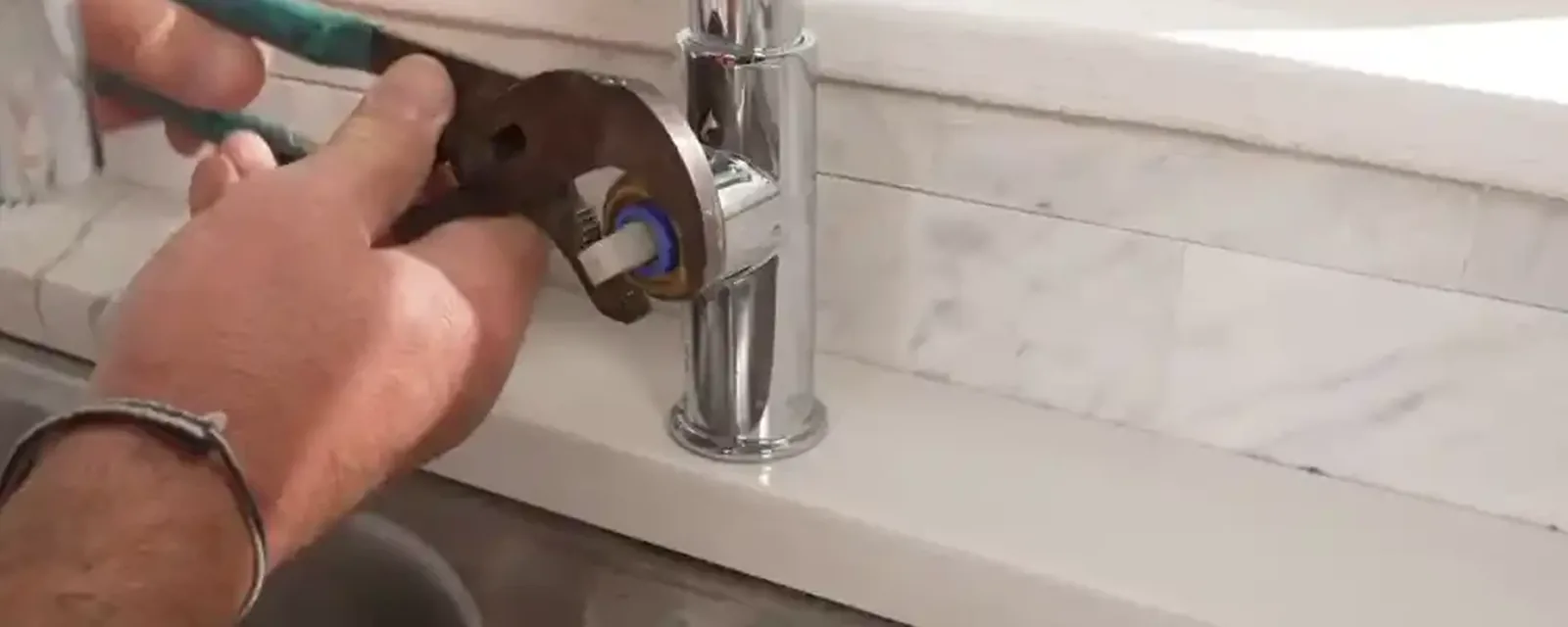
Peerless is a widely used faucet brand, found in many kitchens and bathrooms in newer homes and remodels. Like any faucet, it has a few parts that wear out. A drip from the spout, a leak around the handle, a stiff or loose handle and weak flow account for nearly every service call, and each traces to a specific part. Identify the style first and the fix becomes straightforward.
This guide focuses on the logic of diagnosis, not on one model's steps, because faucet designs vary even within a brand. The plumber identifies the exact model from the faucet body, the handle style and often the model number printed on a tag or a hidden surface.
Step one: which style do you have?
A single-handle faucet that moves up for flow and sideways for temperature usually has one cartridge. A two-handle faucet has separate valve cartridges or stems for hot and cold. Some have ceramic discs, which are tough and last long. Others have rubber seals that wear. Knowing which you have tells you whether the repair is a cartridge swap, a seal kit or a stem replacement.
| Style | Typical wear part | Common symptom |
|---|---|---|
| Single-handle cartridge | Cartridge or O-rings | Drip at spout, leak at handle |
| Two-handle with stems | Washers, seats or stems | Drip from the spout, stiff handles |
| Ceramic disc | Disc cartridge | Drips, hard to shut off |
| Pull-down sprayer | Hose, check valve or diverter | Weak spray, leaks under the sink |
Common problems and what causes them
A steady drip from the spout means the cartridge or seat has worn and the faucet no longer seals. Water around the base of the handle points to a worn O-ring or a loose retaining nut. Weak flow often traces to a clogged aerator, debris in the cartridge or a kinked supply line.
Water under the sink may be the supply line, not the faucet, so check the connections before assuming the faucet is the leak.
Before you call
- Close the shutoff valves under the sink if water is escaping.
- Note whether the leak is from the spout, the handle or the base.
- Look for a model number on the faucet body or an old box or manual.
- Take a photo of the faucet and the area under the sink.
Peerless faucet leaking or stiff?
Call and a plumber will identify the cartridge and fix or replace the faucet with the price set first.
Repair or replace
A cartridge or O-ring repair costs less than a new faucet and takes a short visit. If the faucet is in good shape, repair is the better value. A faucet with a corroded body, a worn finish or discontinued parts is better replaced.
Mismatched generic cartridges sometimes work badly, so the plumber confirms a proper fit rather than forcing a similar part. Our faucet repair page covers pricing and what we check.
When replacing, the plumber also replaces the supply lines and checks the shutoff valves. Old shutoffs that will not close are the reason many faucet repairs become full water shutoffs, and replacing them at the same time avoids that later.
Why faucets fail sooner in some homes
High water pressure shortens faucet life by stressing seals. Water chemistry matters too. Hard water leaves mineral crust that scratches seals and clogs aerators, while soft water is gentler on parts. Chlorine in municipal supply slowly degrades rubber over the years. If your faucets wear out faster than expected, a pressure check is worth doing.
Happy Valley note: soft water and lead rules
Sunrise Water Authority, which serves Happy Valley, describes its water as generally soft at about 1.2 grains per gallon, so mineral crust on aerators is less common than in hard-water areas.
Its 2024 water quality report lists lead at 3 parts per billion at the 90th percentile and copper at 0.065 parts per million, and it notes that homes built before 1985 carry a higher risk of lead leaching from older plumbing.
Most Happy Valley homes are newer than that, but if you live in an older house nearby, ask about faucet and supply line age when you replace fixtures.
Choosing a replacement
If you replace, pick a faucet that matches your sink holes and your use. A single-handle model needs one hole, and a two-handle model needs three on a standard spread. Check that parts for the model you buy are sold in the long term, which makes the next repair simple. A plumber can install a faucet you bought, or help you choose one on the visit.
Faucet pressure problems sometimes point beyond the faucet. If every tap in the house is weak, the issue lies in the supply and not in one fixture, and a plumber can test it. Residents of Clackamas and Damascus with longer service lines should mention that when they call.
What a cartridge swap looks like
A cartridge replacement follows a predictable order. The plumber closes the shutoff valves, opens the faucet to relieve pressure, removes the handle and any retaining nut or clip and pulls out the old cartridge. The valve body is cleaned and inspected for scratches or mineral crust, a new cartridge and new O-rings are lubricated with plumber's grease and seated, then the faucet is reassembled and tested at full flow.
The inspection matters. If the valve body is pitted or scored, a new cartridge will leak again. That is the moment a good plumber tells you the faucet is at the end of its life, rather than selling a repair that will fail. Keep the old cartridge, because it helps confirm the correct match if you ever need a spare.
Spare parts worth keeping
Keep the old cartridge, the model number and a photo of the faucet in a labeled bag under the sink. If you ever need a replacement part, that bag saves guesswork. Keep a small tube of plumber's grease and a spare set of O-rings, and note the date of the repair so you can judge how long the part lasted.
Peerless faucet questions
A worn cartridge, washer or seat is the usual cause. Replacing the worn part stops the drip.
Often it is on a tag on the supply lines, stamped on the underside of the body or printed in the original paperwork. The plumber can also identify it by the parts.
If the body and finish are in good shape and parts are available, yes. If it is corroded or parts are scarce, replacement is often better.
Local water is soft, which is gentle on parts, but high pressure and chlorine still wear seals over the years.
A cartridge or seal repair often takes under an hour. A replacement takes longer if supply lines and shutoffs are also being replaced.