
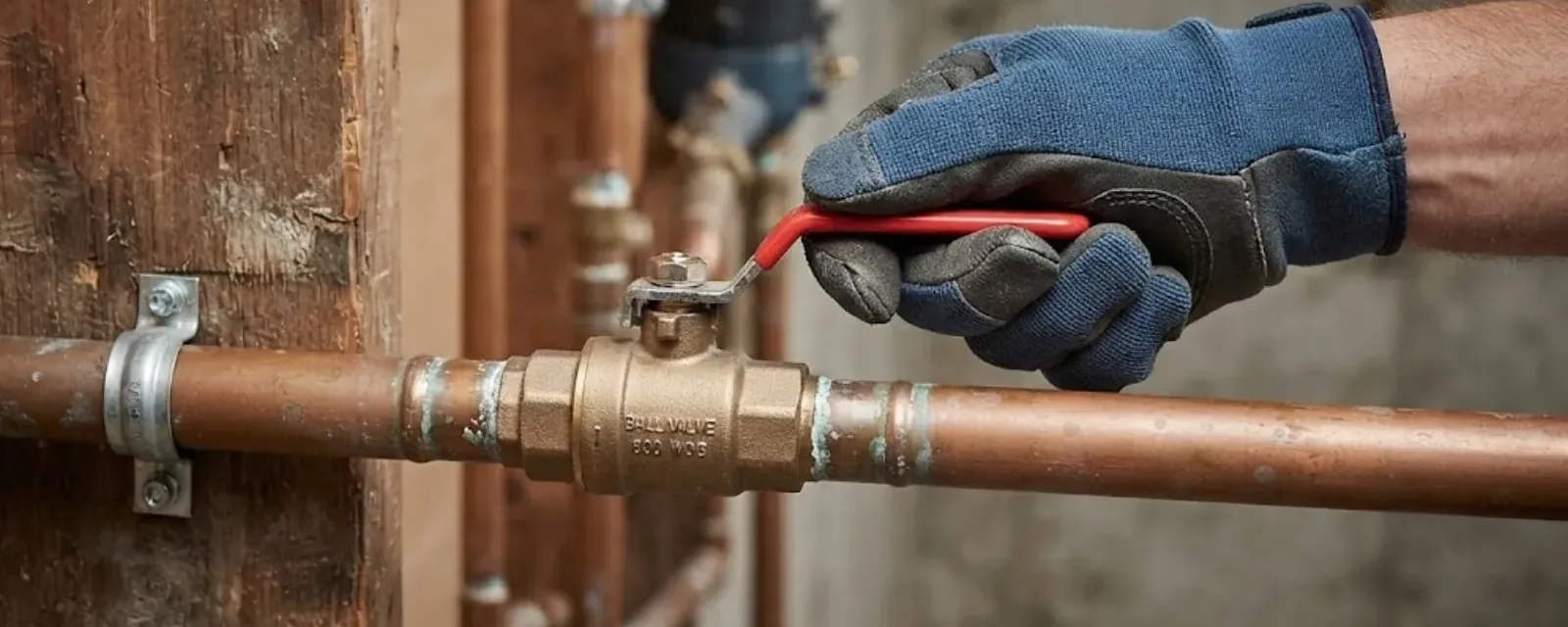
Weak water pressure right after plumbing work is frustrating, and it is nearly always fixable without redoing the repair. When water was shut off and turned back on, debris, air and valve positions change. The cause is often an aerator clogged with grit, a shutoff valve that was not fully reopened or air trapped in the lines.
The trick is to find out whether the weakness is at one fixture or at all of them.
If every tap is weak, the problem is upstream: a main valve, a regulator or the supply line. If only one fixture is weak, the problem is local to that fixture. That single observation cuts the search in half.
Check one fixture first
Unscrew the faucet aerator, the small screen at the tip of the spout, and look for grit and bits of pipe sealant or debris. Rinse it and replace it. After water has been shut off and restored, sediment that was sitting in the lines gets stirred up and lodges in these screens.
Run the water for a minute with the aerator off to flush the line, then reinstall it. Showerheads have similar screens.
Check the valves
The main shutoff valve may not be fully open. Gate valves, with round handles, need to be turned all the way counterclockwise. Ball valves, with lever handles, should be in line with the pipe when open. Valves at fixtures should also be fully open. A valve left partly closed after a repair is the most common cause of reduced flow in the whole house, and it takes seconds to check.
| Symptom | Likely cause | Check |
|---|---|---|
| One faucet weak | Clogged aerator or cartridge | Clean the aerator, flush the cartridge |
| Hot water weak only | Heater shutoff partly closed, sediment | Check valves at the heater |
| Whole house weak | Main valve partly closed, regulator problem | Check the main valve, test pressure |
| Sputtering and air bursts | Trapped air | Open taps to purge the line |
| Pressure fine, flow weak | Kinked or narrow line | Inspect the line, call a plumber |
Pressure still low after a repair?
Call and a plumber will test pressure and flow and find the cause.
Air in the lines
After repairs, air gets trapped in the pipes and shows up as sputtering and spitting. Opening each tap, starting with the highest one in the house, lets the air escape. Open the cold tap first, then the hot, and run each for a minute. The sputtering usually stops within a few minutes.
A simple pressure test
- Screw a pressure gauge onto an outdoor spigot, with all water off in the house.
- Open the spigot fully and read the gauge.
- Normal household pressure is generally between about 40 and 80 psi.
- Below that range, or above it, call a plumber to check the regulator and supply.
When it points to something bigger
If checks do not solve it, the cause may be a failed pressure regulator, a partly closed or corroded main valve, a kinked supply line or a leak. A leak reduces the pressure available at the fixtures and shows up as a moving water meter with all taps off. Our leak detection page explains the search.
If the regulator has failed, pressure may be too low or, worse, far too high, which strains fixtures.
A repair that touched the water heater or a shutoff is also worth rechecking. A heater isolation valve that is not fully open reduces only hot water flow, which is a clue you can use when describing the problem.
Happy Valley note: main valve location and pressure on the slopes
Sunrise Water Authority notes that a customer's main shutoff is typically in the garage or crawlspace, and that the utility is responsible only up to the outlet side of the meter. That means the valve you need to check is likely inside your home. Because Happy Valley climbs the flank of Mount Scott, static pressure varies with elevation.
Homes at lower points can run high, and homes at higher points can run lower, so a baseline reading from your own spigot is more useful than a general rule.
Calling the plumber back
If the weakness started right after a repair, tell the plumber what was done and what has changed. Most reputable contractors want to know, and a call is the quickest way to rule out an oversight. If you live in Clackamas or Oregon City and the work involved older galvanized pipe, mention that.
Older lines can shed debris when disturbed, and a repair may have loosened buildup that now clogs a fixture.
Hot only, cold only and other patterns
The pattern of weak flow tells you where to look. If only hot water is weak, the problem sits between the water heater and the tap, often a partly closed valve at the heater or sediment in the heater itself. If only cold water is weak at one tap, check that tap's aerator and its shutoff valve.
If both hot and cold are weak at one fixture, the cartridge or the supply lines to that fixture are likely restricted.
A sudden loss across the whole house right after the water was shut off points to the main valve or the pressure regulator. Check the main first, then the regulator, which is a bell-shaped brass fixture near where the water enters the home. A regulator that has failed can swing pressure too low or far too high, and replacing one is routine plumbing work.
Finally, think about timing. Pressure that drops at the same hour each evening may reflect heavy neighborhood use and not a problem in your home. A gauge reading at different times of day shows the pattern, and that reading helps a plumber tell whether the cause is inside your walls or out at the street.
A short list before you call back
Gather these before you phone the plumber: the date of the repair, what was replaced, whether the weakness is hot, cold or both, which fixtures are affected and what a pressure gauge reads at an outdoor spigot. Add whether the problem started the moment water was restored.
That short list lets the plumber diagnose by phone and arrive with the right parts, which saves time and cost on the return visit.
Pressure reference
Home water pressure is regulated at the supply side, and the Oregon Plumbing Specialty Code (OPSC), based on the Uniform Plumbing Code (UPC), sets limits on static pressure at fixtures. A pressure gauge on a hose bib gives you a number to share with a plumber.
Low pressure questions
Usually a clogged aerator, a shutoff valve not fully reopened or air in the lines. Check those first.
Open all taps, starting with the highest, and run each for a minute, cold first, then hot, until the water flows smoothly.
Generally about 40 to 80 psi. A gauge on an outdoor spigot gives you a reading.
Sunrise Water Authority notes it is typically in the garage or crawlspace. Look near where the water line enters the home.
Yes. A leak steals pressure. If the meter moves with everything off, call a plumber to find it.