
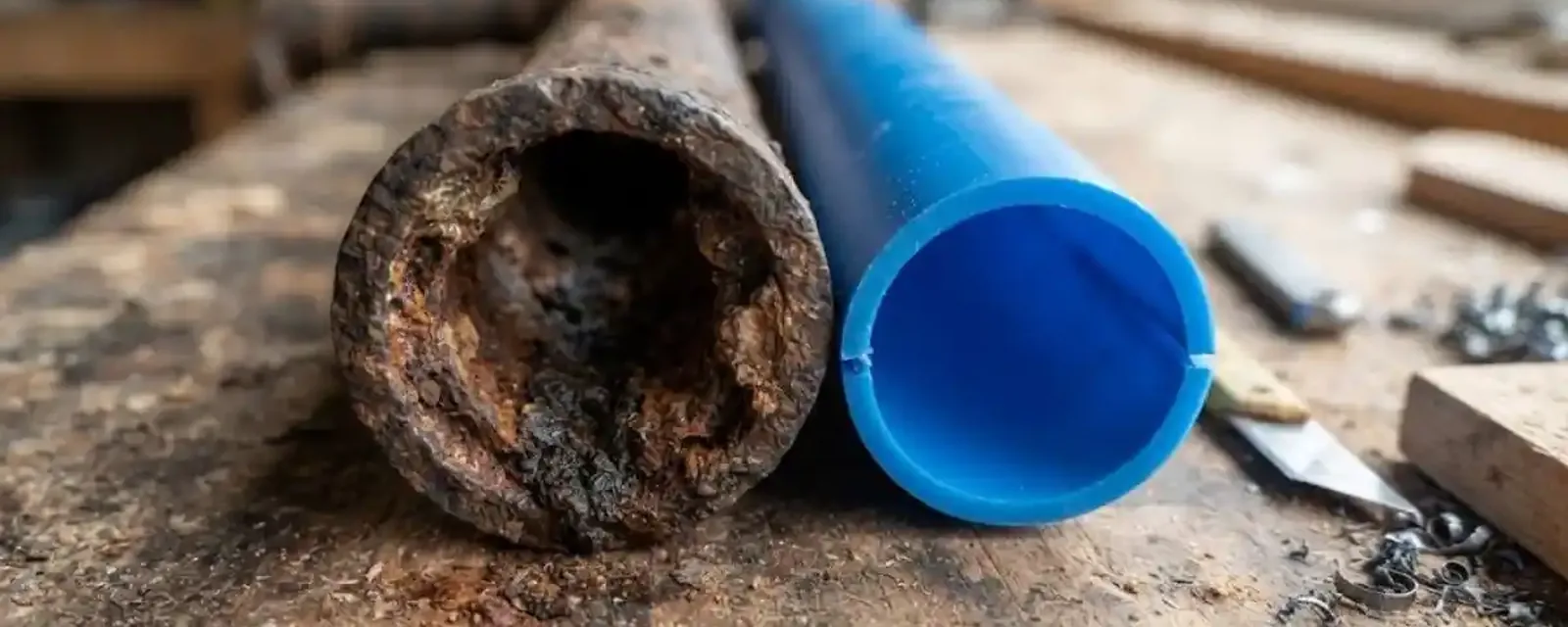
A repipe is the replacement of the water supply piping in a home, either all of it or a large section. It does not include the drain pipes, which carry waste out, but the pressurized lines that bring water to every tap, toilet and appliance. People repipe because the existing pipes are failing, with repeated leaks, discolored water or falling pressure, or because the material has a poor track record.
A single leak is a repair. A pattern of leaks is a warning that the system is wearing out, and repairing one spot at a time often costs more over the long run than replacing the lines.
Signs it may be time
Repeated pinhole leaks in different places, rust-colored or metallic-tasting water, pressure that has dropped over time, green or white crust at copper joints and visible corrosion on galvanized pipe are the main signs. Houses built with certain materials, such as galvanized steel or polybutylene, are common candidates. Water stains on ceilings or in cabinets from repeated leaks also count.
Signs to note before a plumber visits
- How many leaks have you had, and where?
- Is the water discolored when you first open a tap?
- Has pressure dropped over the years?
- What material are your visible pipes, such as in the garage or crawlspace?
PEX, copper and other choices
PEX is flexible plastic tubing that runs in long lengths with few fittings, tolerates freezing better than rigid pipe and installs quickly. Copper is rigid, long-lived and well understood, but costs more. CPVC is a rigid plastic used in many newer homes. Each is acceptable under the Oregon Plumbing Specialty Code when installed correctly. The decision depends on budget, house layout and preference.
| Material | Strengths | Trade-offs |
|---|---|---|
| PEX | Fast install, fewer joints, freeze tolerant | Not for outdoor exposure to sunlight |
| Copper | Long life, rigid, familiar | Higher cost, more labor, can pit in some water |
| CPVC | Low cost, rigid plastic | Can be brittle, sensitive to some chemicals |
Pipes leaking again and again?
Call and a plumber will assess the system and tell you whether a repipe or a repair is the better value.
What the work looks like
The plumber maps the lines, plans routes, opens small access points in walls, ceilings or crawlspaces and installs new pipe to each fixture. The water is shut off during parts of each day, and the plumber plans so you have water overnight where possible. Each new line is pressure tested, and the old lines are abandoned or removed. Wall openings are left ready for patching and painting by another trade.
A whole-house repipe commonly takes several days, depending on the size and access. A partial repipe, such as one bathroom group or a crawlspace run, can take a day or two. Our repiping page describes the steps and the pricing factors.
Repair first, or repipe?
If the failure was a one-off, such as a freeze or an impact, a repair is enough. If leaks keep appearing, or the material is known to fail, repiping is the better value. A plumber's assessment should look at the pipe's condition and your history of problems. When a leak is active, burst pipe repair comes first, and the longer plan follows.
Happy Valley note: what local pipes tend to be
Happy Valley grew from about 1,500 housing units in 2000 to more than 8,000 by 2020, so most homes use PEX or CPVC rather than galvanized steel. A full repipe is therefore less common than in older neighbors, and usually follows a specific failure, such as a defective fitting or a manifold problem.
Clackamas River Water, which serves parts of the area, notes that aging galvanized pipes can release rust particles into household water. Sunrise Water Authority's 2024 report notes that homes built before 1985 carry a higher risk of lead leaching from older plumbing. Permit and inspection rules for repiping vary by project, so ask the Happy Valley Building Division.
Planning around the disruption
Ask for a written scope that lists the pipe material, the number of fixtures, the wall openings expected and who patches them. If you plan a remodel soon, coordinate, since open walls save money. Arrange for pets and children to be away from work areas and clear access to the water heater, the main valve and any crawlspace. Our plumber will explain the schedule, including when water will be off.
In Milwaukie and Oregon City, where older galvanized and copper systems are more common, the assessment often leads to a staged plan that spreads the cost. In Clackamas, where homes vary in age, the age of the specific house decides.
Cost factors and how to compare quotes
Repipe quotes vary widely, and the differences are rarely mysterious. Size comes first: more fixtures and more feet of pipe mean more labor. Access matters, since a single-story home on a crawlspace is easier than a multi-story house with finished walls. Material choice changes the price, and so does the number of wall openings the plumber expects to make. Permit and inspection steps add some cost in most jurisdictions.
To compare quotes fairly, ask each plumber to list the pipe material, the fixture count, the manifold or trunk layout, the wall openings and who handles patching. Ask what is excluded, such as drywall, paint and insulation, and whether the water heater connections are included. A low price that leaves out patching may cost more than a higher price that includes it.
Finally, ask how the plumber will protect your home during the work, including floor protection and dust control, and what the schedule is for water shutoffs. Those details show how organized the crew is, which matters as much as the number on the page.
Questions to ask before you sign
Ask whether the quote covers permits, inspection and patching, what the warranty on labor is and who supplies and stands behind the pipe. Ask how the water will be handled during the work, and how many days the house will be affected. Ask what happens if hidden damage is found inside a wall. Clear answers to these questions show how organized the job will be.
Code and permit reference
Repiping follows the Oregon Plumbing Specialty Code (OPSC), based on the Uniform Plumbing Code (UPC), and normally includes pressure testing. Permit rules vary, so ask the Happy Valley building department before work begins.
Repiping questions
A repair fixes one failed spot. A repipe replaces a large part or all of the supply system. Repeated failures point toward a repipe.
Several days for a whole house, depending on size and access. A partial repipe may take a day or two.
Usually for substantial plumbing work, and rules vary. Ask the Happy Valley Building Division.
Water is off for parts of each day, and plumbers plan so you have water at night when possible.
PEX approved for potable water is widely used and accepted by plumbing code. The plumber uses approved products.