
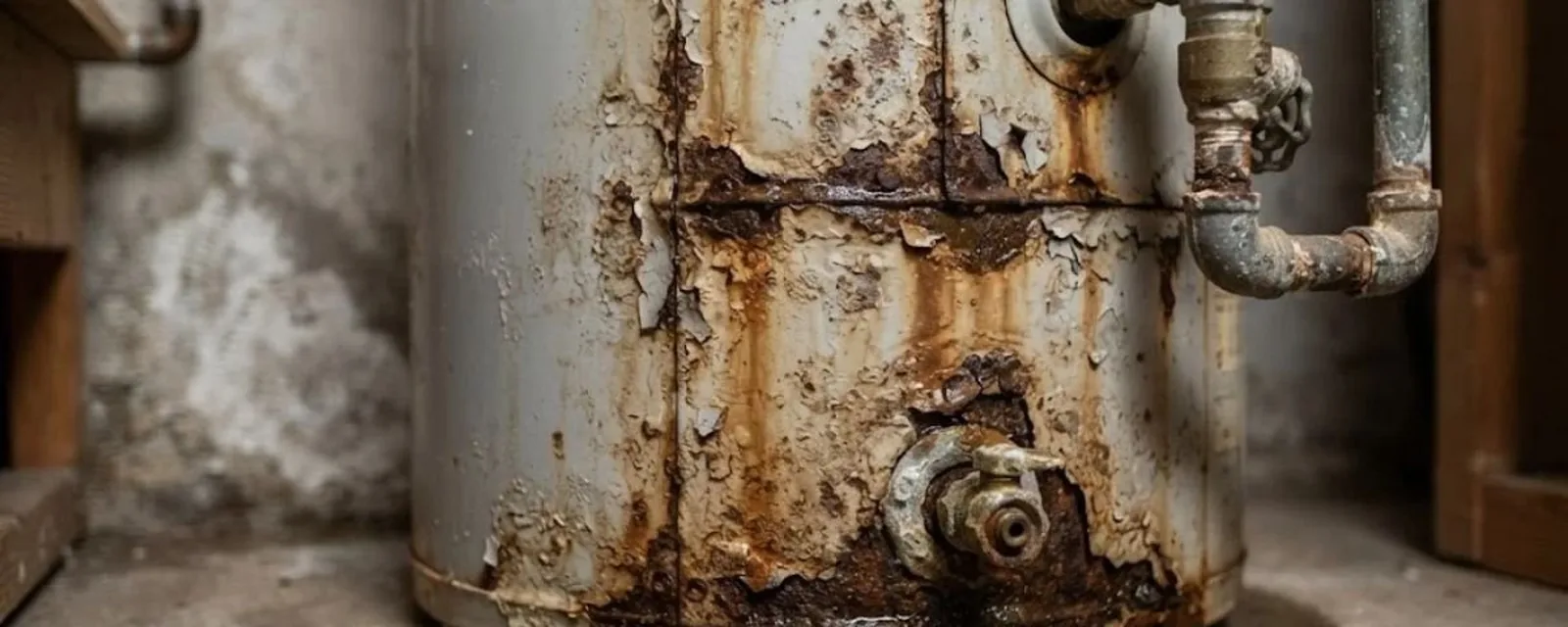
A leaking water heater is a decision point. Some leaks are cheap to fix, such as a loose fitting or a dripping valve. Others mean the steel tank has corroded through, and no repair will hold. The first job is to stop the damage. The second is to learn where the water is coming from, because that tells you which situation you are in.
Shut off the cold water supply to the heater at the valve above it, turn off the gas control or the breaker, and open a hot tap upstairs to relieve pressure. Then look.
Where is the water coming from?
Look at the top of the tank, the sides, the bottom and the pipes. Water at the top, near the fittings, often comes from a loose or corroded connection. A drip from the discharge pipe off the relief valve points to pressure or temperature. Water at the drain valve means a loose or failing valve.
Water seeping from the base or from under the insulation jacket is the one that signals a failed tank.
| Location | Likely cause | Usually repairable? |
|---|---|---|
| Top fittings | Loose or corroded connection | Yes |
| Relief valve discharge | High pressure, temperature or a worn valve | Yes |
| Drain valve | Worn valve or loose cap | Yes |
| Side or base, under the jacket | Tank liner failure | No, replace the heater |
| Water on floor, source unclear | Condensation or multiple sources | Needs a plumber's check |
Condensation is not a leak
Gas heaters, especially high-efficiency models, can produce condensation, and cold water pipes sweat in humid air. A small amount of moisture that appears and dries is not necessarily a leak. If it keeps appearing at the same place and the floor under the unit is wet, it is a leak. A plumber can tell the difference in a minute.
First minutes
- Turn off the cold water supply valve above the heater.
- Turn off the gas control or the breaker.
- Open a hot tap upstairs to relieve the pressure.
- Put towels or a pan under the leak and photograph the damage.
Water heater leaking right now?
Shut off the cold supply and the power, then call and a plumber will respond.
What the tank itself is telling you
Steel tanks are protected inside by a glass lining and a sacrificial anode rod. When the rod is used up, the steel starts to corrode. Rust-colored hot water, a rotten egg smell and a tank older than about a dozen years all suggest the tank is nearing the end. A leak from the tank body is the final stage. It cannot be patched, and the heater should be replaced.
Clackamas River Water notes that white particles in hot water can come from a disintegrating plastic dip tube inside a water heater, which is a repair clue rather than a tank failure. If you see flakes, mention them when you call.
Repair or replace: a quick rule
Repair when the leak is at a fitting or valve and the tank is sound and under about a dozen years old. Replace when the leak is from the tank, when the heater is older than that and showing rust or when the repair would cost a large share of a new heater.
Our water heater repair page explains the checks. A plumber should show you the leak and give you both prices before you decide.
Questions to ask the plumber
- Where exactly is the leak, and can you show me?
- How old is the tank, and what shape is the anode rod in?
- What would repair cost, compared with replacement?
- If I replace, is the pan, expansion tank and bracing included?
What a replacement includes
A proper replacement fits a new heater on a drain pan, installs a new relief valve with a full-size discharge pipe, replaces worn connectors and sets bracing against earthquake movement. If your tank is in a closet or garage, a pan with a drain line limits damage from the next leak. The details are on our water heater replacement page.
Happy Valley note: age of local tanks and soft water
Happy Valley grew from about 1,500 housing units in 2000 to more than 8,000 by 2020, so many builder-grade heaters from the early building waves are now in the 12 to 15 year range, which is when tank failures become common.
Sunrise Water Authority's supply is generally soft, at about 1.2 grains per gallon, so heavy scale is rarely the cause here. A worn anode rod and age are more common reasons. Permit rules for a replacement vary by project, so ask the Happy Valley Building Division, and we can describe the work for that call.
Cleaning up and next steps
Dry the area quickly, and photograph everything for insurance. Wet insulation or drywall near the heater should be assessed for drying. If water spread to flooring, a restoration contractor handles drying and mold control, and we can tell you what to ask. For homes in Milwaukie or Oregon City, where basement heaters are common, a drain pan with a drain line is especially valuable.
Preventing the next leak
A few habits protect a new tank. Install a drain pan with a drain line, and a leak alarm near the heater if it sits above finished space. Flush sediment once a year, test the relief valve as the manufacturer advises and have the anode rod checked every few years.
A tank with a working expansion tank is under less stress than one without, so confirm yours is charged. Know where the cold supply valve is, so the next time something drips you can shut it in seconds.
Insurance and paperwork
Photograph the heater, the leak and any wet materials before you clean up. Keep the plumber's written description of the cause, since insurers often ask whether the damage was sudden or gradual. Save receipts for the new heater and any drying work. Ask your insurer what your policy covers before you decide on repairs, because coverage for gradual leaks differs from sudden failures.
Code reference
Replacement heaters are set with relief valves, discharge piping and bracing under the Oregon Plumbing Specialty Code (OPSC), based on the Uniform Plumbing Code (UPC). Ask the Happy Valley building department whether your replacement needs a permit.
Leaking water heater questions
Yes. Shut off the cold supply and the power or gas, then call. Water damage grows quickly.
A leak from the tank body cannot be repaired and the heater must be replaced. Leaks from fittings or valves often can be.
Water coming from the base or under the jacket, rust-colored water and age over a dozen years all suggest tank failure.
Not necessarily. Moisture that appears and dries can be condensation. A persistent wet floor is a leak.
Typically around 10 to 15 years. Many local tanks are now in that range because the area grew quickly after 2000.