
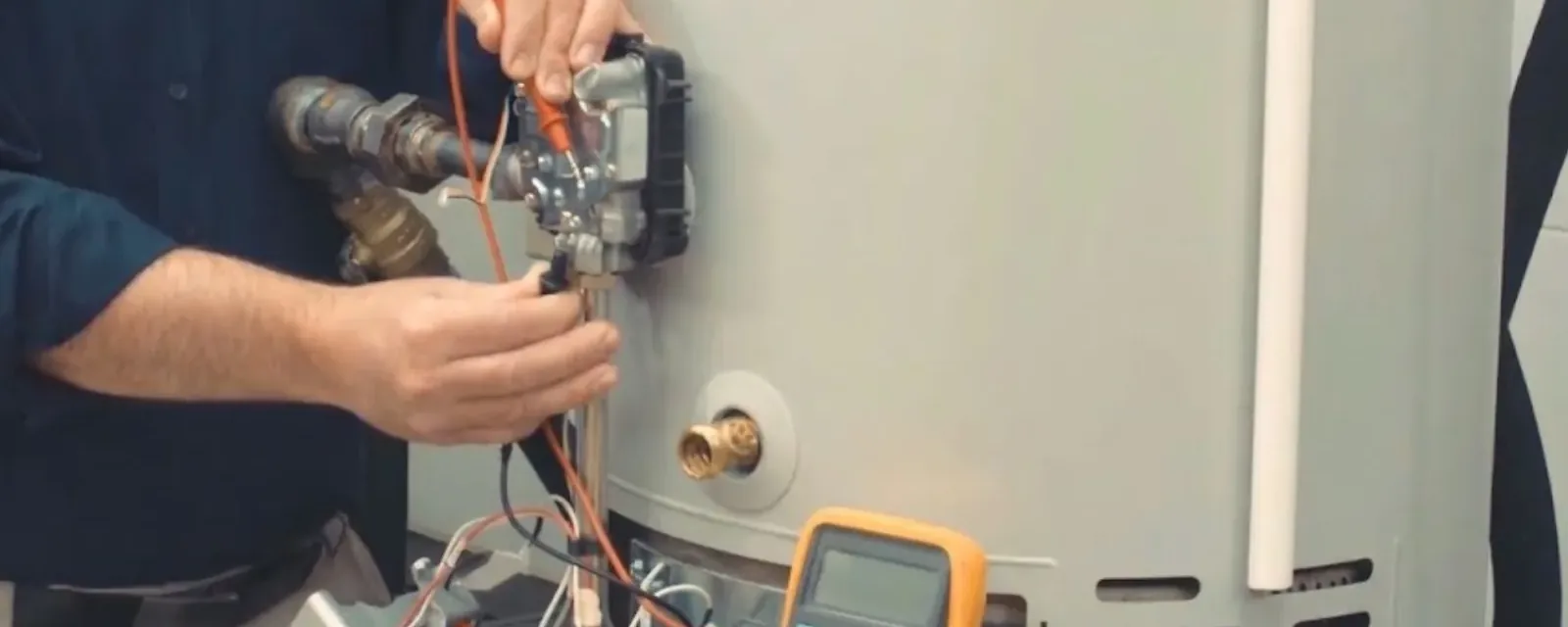
If your gas water heater has no pilot, no burner or no hot water, the gas control valve is one of three or four possible causes, and it is rarely the first one to check. A new thermocouple or flame sensor fixes many of these problems for far less money.
A failed gas control valve, the box at the bottom of the tank with the dial and the pilot button, is a real repair, but it is only worth doing on a tank that is otherwise sound.
If you ever smell gas, do not touch switches or try to relight anything. Leave the home and call 911 or your gas utility first. This article is for the more ordinary case: a heater that will not light, will not stay lit or heats badly, with no gas odor.
What the gas control valve actually does
The gas control valve is the heater's brain and its safety latch. It senses water temperature through a probe, opens the gas supply when the tank needs heat, and shuts the gas off if the flame goes out or the temperature runs too high. It also feeds the pilot assembly. When it wears out, the symptoms look like other problems, which is why plumbers test the cheaper parts first.
Signs the valve may be failing
A valve that has failed internally can show up as a pilot that lights and then drops out even after a new thermocouple, a burner that does not fire when the tank is cold, a dial that feels loose or will not click, or water that never gets as hot as the setting.
A valve that is stuck open or leaking gas is a safety problem, and the plumber shuts the unit down.
| Symptom | Most likely cause | Check first |
|---|---|---|
| Pilot will not stay lit | Worn thermocouple or flame sensor | Replace the sensor |
| Pilot lights, burner does not fire | Failed gas control valve or thermopile | Test voltage and valve operation |
| Burner fires, water stays lukewarm | Dirty burner, weak draft or bad thermostat portion of the valve | Clean burner, check venting |
| Dial loose or will not click | Worn valve | Replace the control valve |
| Pilot flame yellow or sooty | Poor combustion air or venting problem | Inspect vent, clean burner |
Gas water heater won't stay lit?
Call and a plumber will test the thermocouple and gas control valve before recommending a repair.
A sensible order of diagnosis
A plumber works from cheapest to costliest. First comes the thermocouple or flame sensor, which cost little and fail often. Next comes the pilot assembly and burner, which collect dust and soot. Then comes venting, since a poor draft can snuff the flame. Only after those pass does the gas control valve get replaced. Starting at the valve is how people pay for a part they did not need.
Replacing the valve: what the job involves
The plumber shuts off the gas and the water supply to the heater, drains enough water to work, removes the old valve, installs the new one with fresh thread sealant rated for gas, reconnects the pilot and burner assemblies and relights the heater.
Every joint is leak tested with a bubble solution or a gas detector, and the burner flame and vent draft are checked before the visit ends. Gas work has no room for improvisation, which is why this is a job for a licensed plumber.
Repair or replace the heater?
A new gas control valve on a young tank makes sense. On a tank near the end of its life, it can be money spent on a heater that will leak within a year or two.
Look at three things: the age of the tank, any rust or moisture at the base, and the price of the valve compared with a new tank. When the heater is past about a dozen years or shows signs of corrosion, water heater replacement is usually the sounder choice.
If the tank is young and clean, a valve swap under water heater repair is reasonable.
Questions to ask before approving a valve replacement
- How old is the tank, and does it have rust or moisture at the base?
- Were the thermocouple, pilot and burner tested first?
- What does the valve cost compared with a new tank of the same size?
- Does the repair come with any warranty on parts and labor?
What drives the cost
Cost depends on the valve itself, which varies by brand and model, the labor to swap it and any related parts that turn up during testing. Valves are specific to a heater's make, so a plumber has to identify the model before ordering. Typical repairs of this kind run into the low hundreds of dollars rather than thousands, but a quote after diagnosis is the only reliable number.
Happy Valley note: permits, age and local conditions
Happy Valley's housing stock grew quickly, from roughly 1,500 housing units in 2000 to more than 8,000 by 2020, so a large number of gas heaters here are now 12 to 15 years old. At that age, a failed control valve is often the first sign the tank is wearing out, and the decision leans toward replacement.
The city's Building Division, at City Hall on SE Misty Drive, administers the Oregon specialty codes and handles plumbing permits through the state's online permitting system. Whether a valve replacement needs a permit varies, so ask the building department. We describe the work in plain terms to help that conversation.
Habits that protect the valve
Keep the area around the heater clear so combustion air can reach it. Do not store paint, solvents or chemicals nearby, because vapors can affect a flame and are a safety hazard. Flush the tank once a year to reduce sediment, and look at the burner and vent connection during that visit.
If you live near Clackamas or out toward Damascus, where many homes are on gas heaters of similar age, an annual check by a plumber can catch a failing sensor before you lose hot water.
Gas safety and code
If you smell gas, leave the home and call 911 or your gas utility. Gas valve and heater work follows the Oregon Plumbing Specialty Code (OPSC), based on the Uniform Plumbing Code (UPC), and permit rules vary, so ask the Happy Valley building department.
Gas water heater valve questions
If the pilot lights while you hold the button but goes out when you release it, the thermocouple or flame sensor is the usual cause. If a new sensor does not help, the gas control valve is next on the list.
Gas connections must be leak free, and an error can cause a leak or a fire. It is work for a licensed plumber, with a leak test at the end.
Permit rules vary by project, and the answer depends on what the work involves. Ask the Happy Valley Building Division, and we will describe the work so you can ask the right question.
Often not. At that age the tank itself is near the end of its life, and the cost of a new valve may be better applied to a new heater.
Do not light anything or touch switches. Leave the home, then call 911 or your gas utility from outside, and call us after the area is declared safe.