
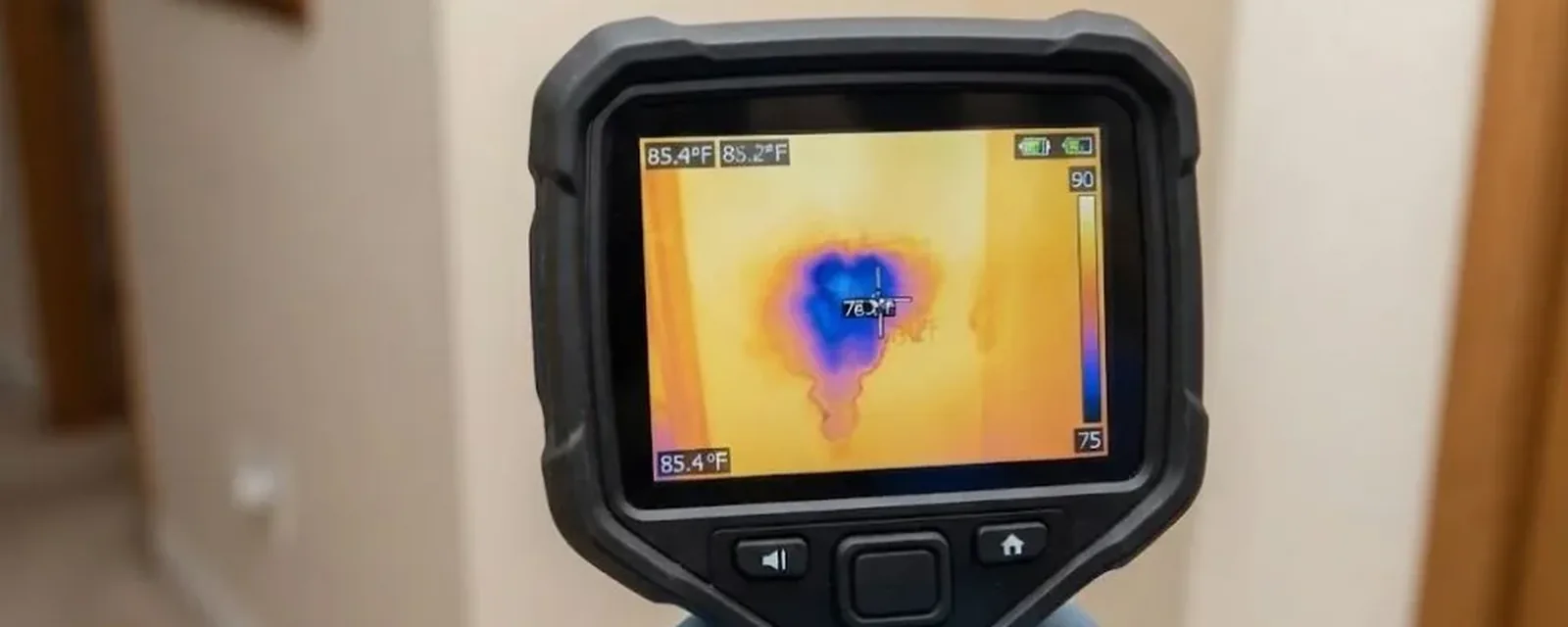
An infrared camera does not see water. It sees temperature. A wet patch behind drywall is usually a different temperature from the dry surface around it, and the camera turns that difference into a color map. In the right conditions, that map points directly at a leak.
In the wrong conditions, it points at nothing, or at something that is not a leak. That is why plumbers treat it as one tool among several.
The most useful way to think about thermal imaging is as a way to decide where to look. It narrows a large area to a small one, so the next test, whether listening or a pressure check, can be targeted. A plumber who relies on the camera alone will sometimes cut the wrong spot.
What the camera can find
Thermal imaging works best for hot water lines. A leaking hot line under a floor or in a wall warms the surrounding material, and the camera shows a bright patch. It also finds wet insulation, which holds a different temperature from dry insulation, and cold spots where a cold water line leaks into a wall. In slab homes, radiant heating lines can be traced to find a failure.
| Situation | What the camera shows | Reliability |
|---|---|---|
| Hot water line leaking under a floor | Warm patch on the floor | Good |
| Leaking cold line in a wall | Cool, damp area on the wall | Moderate |
| Wet insulation in an attic or crawlspace | Temperature difference in the material | Good |
| Roof or window leak | Temperature differences near the opening | Moderate, varies with weather |
| Small, slow drip | Little or no thermal difference | Poor |
Where it falls short
Thermal imaging struggles with small leaks that produce little temperature change, with thick materials such as concrete slabs, and with situations where sunlight or heating vents create warm and cool areas that are not leaks. Metal, foil-backed insulation and reflective surfaces can also fool a camera. A plumber with experience reads the picture with those traps in mind.
Suspect a hidden leak?
Call and a plumber will use thermal imaging, listening gear and pressure tests to find it.
Why plumbers combine tools
Acoustic listening picks up the sound of pressurized water escaping from a pipe, which works regardless of temperature. Pressure testing isolates sections of piping and shows which one drops. A meter test shows whether a leak exists at all. Used together, they confirm each other. If the camera shows a warm patch and the listener hears escaping water at the same spot, the plumber can open the wall with confidence.
A good search follows this order
- Meter test to confirm that water is leaking.
- Isolation by closing valves to find which part of the system is affected.
- Thermal and acoustic scanning of the suspect area.
- A small, targeted opening, followed by repair and a pressure test.
What to expect during a visit
The plumber asks where you saw staining or felt warmth, checks the meter and then scans walls and floors. The camera works best when there is a temperature difference between the pipe water and the room, so a hot water line leaking in a cool house is easiest.
The plumber may ask you to run hot water at a tap or to turn off the heating briefly. Afterward, you get an explanation of what was found, where and what repair is likely.
You can read our leak detection service page for how pricing works. The price is explained before the search begins, and repair is quoted separately once the source is known.
Happy Valley note: crawlspaces, slopes and pipe types
Happy Valley homes are mostly newer, with PEX or CPVC supply lines, and many have crawlspaces or attic runs where a leak can soak insulation before it shows up inside. That is a good case for thermal imaging, which shows wet insulation well.
The area also has seasonal rain, so crawlspace moisture can come from groundwater as well as pipes, and the plumber has to tell them apart. Sunrise Water Authority is responsible for the water system up to the meter, so any leak in the house or the buried line after the meter is the homeowner's.
After the leak is found
Once the source is identified, the plumber repairs the pipe, tests it and tells you what to expect for drying and repair of finishes. We do not claim to handle drywall or mold work, but we can describe what the next contractor will need. Document everything with photos for insurance.
If you live in Milwaukie or Oregon City, where older pipe is more common, ask about a pipe condition check at the same visit.
Preparing your home for a thermal scan
A little preparation makes a scan more accurate. Clear furniture and stored items from the suspect wall or floor so the plumber can see the surface. Avoid running heating or air conditioning strongly right before the visit, since those change surface temperatures and can mask or mimic a leak.
If the problem involves a hot water line, the plumber may ask you to run hot water at a tap for a few minutes so the line is warm.
Tell the plumber about the history of the area. Past leaks, repairs, roof problems or window leaks all leave temperature patterns that are not new. If you saw staining that has since dried, point out where it was. The camera is only as useful as the questions it is aimed at.
Expect the plumber to confirm any thermal clue with a second method before cutting. That might be a listening device on the nearest pipe, a pressure test of that section or a moisture meter reading. The goal is to open one small spot, not three. When the repair is done, a final scan shows whether the area is drying as expected.
Questions to ask before you hire
Ask what tools the plumber uses besides the camera, how they confirm a finding before cutting and whether the search price is stated up front. Ask what happens if no leak is found, since a clear result is still useful information. A plumber who answers plainly, and who says the camera is only one clue, is the one to hire.
Reference notes
Infrared detection is a screening tool, not a code test. Repairs that follow it are done under the Oregon Plumbing Specialty Code (OPSC), based on the Uniform Plumbing Code (UPC), and a licensed plumber confirms the source before opening walls.
Infrared leak detection questions
No. It shows surface temperature, and a leak shows up when it changes the temperature of the wall or floor surface. It works best combined with other tools.
No. Small or slow leaks and thick materials like concrete can hide from it. Acoustic and pressure tests fill the gaps.
Note where you saw staining or felt warmth, check the meter and be ready to run hot water at a tap if asked.
Usually only a small opening at the located spot. The plumber explains why before cutting.
Yes. It shows wet insulation well, which helps find leaks in crawlspace and attic runs.